Every summer, school custodial teams and facility managers face the same compressed timeline: get the building clean before students arrive. Classrooms stripped and refinished, restrooms sanitized, hallways cleared — and carpeted spaces vacuumed thoroughly after months of reduced traffic kicked up settled dust and allergens.
For facilities running that kind of schedule, equipment choice matters. Backpack vacuums for commercial facilities have become a preferred tool for schools, building service contractors, and office buildings, not because they are novel, but because they consistently deliver better performance where upright and canister vacuums fall short. This post covers what makes them effective, when they are the right fit, and what to evaluate before adding them to your custodial program.
Why Custodial Teams Are Switching to Backpack Vacuums
Traditional upright vacuums are familiar and widely used, but they come with real operational limitations in commercial environments. They restrict the operator to a narrow cleaning path, require frequent repositioning around furniture and obstacles, and place repetitive strain on the wrist and lower back during extended cleaning sessions. In an environment like a K-12 school — where custodial staff may clean dozens of classrooms in a single shift — those limitations add up.
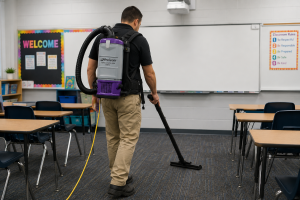
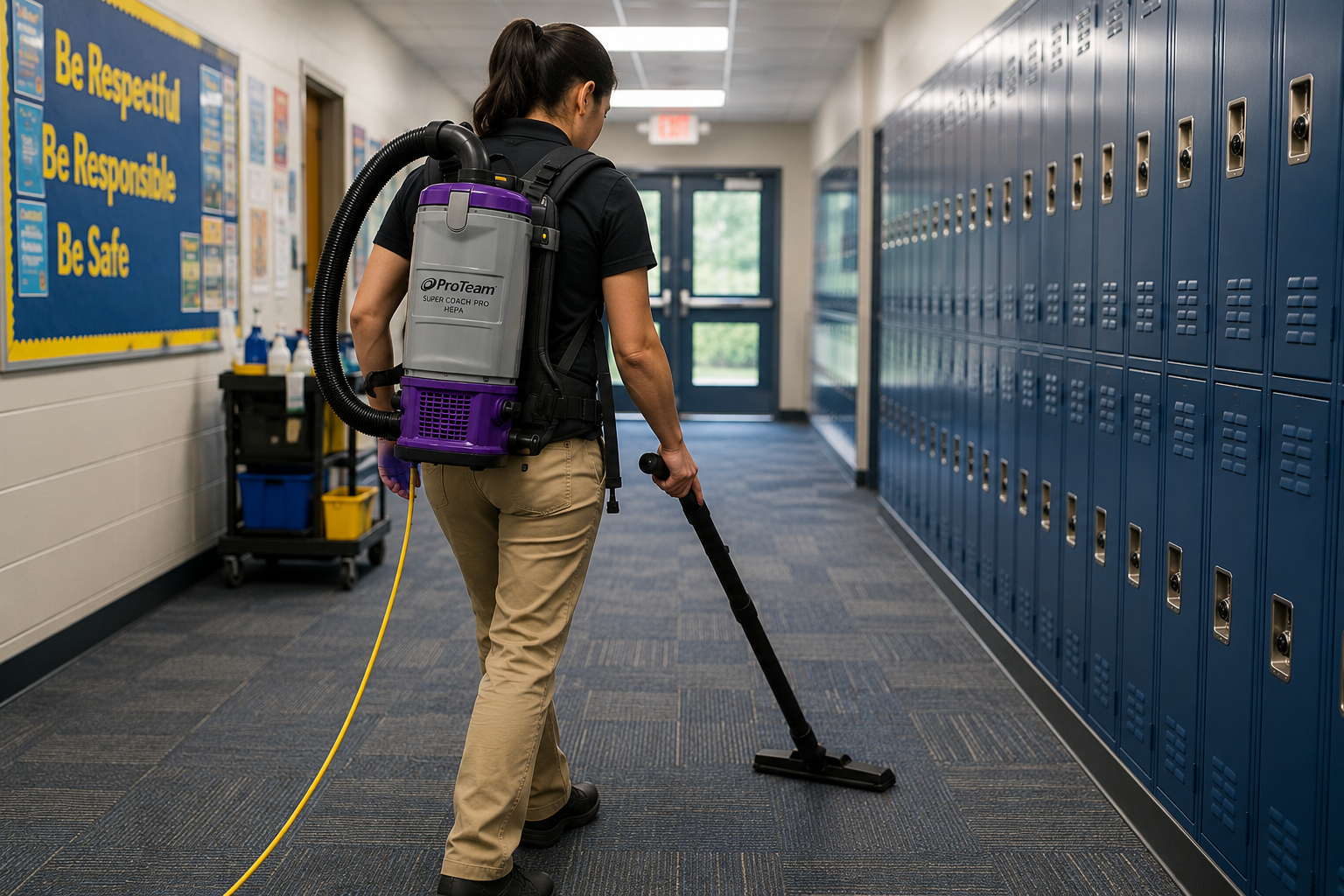
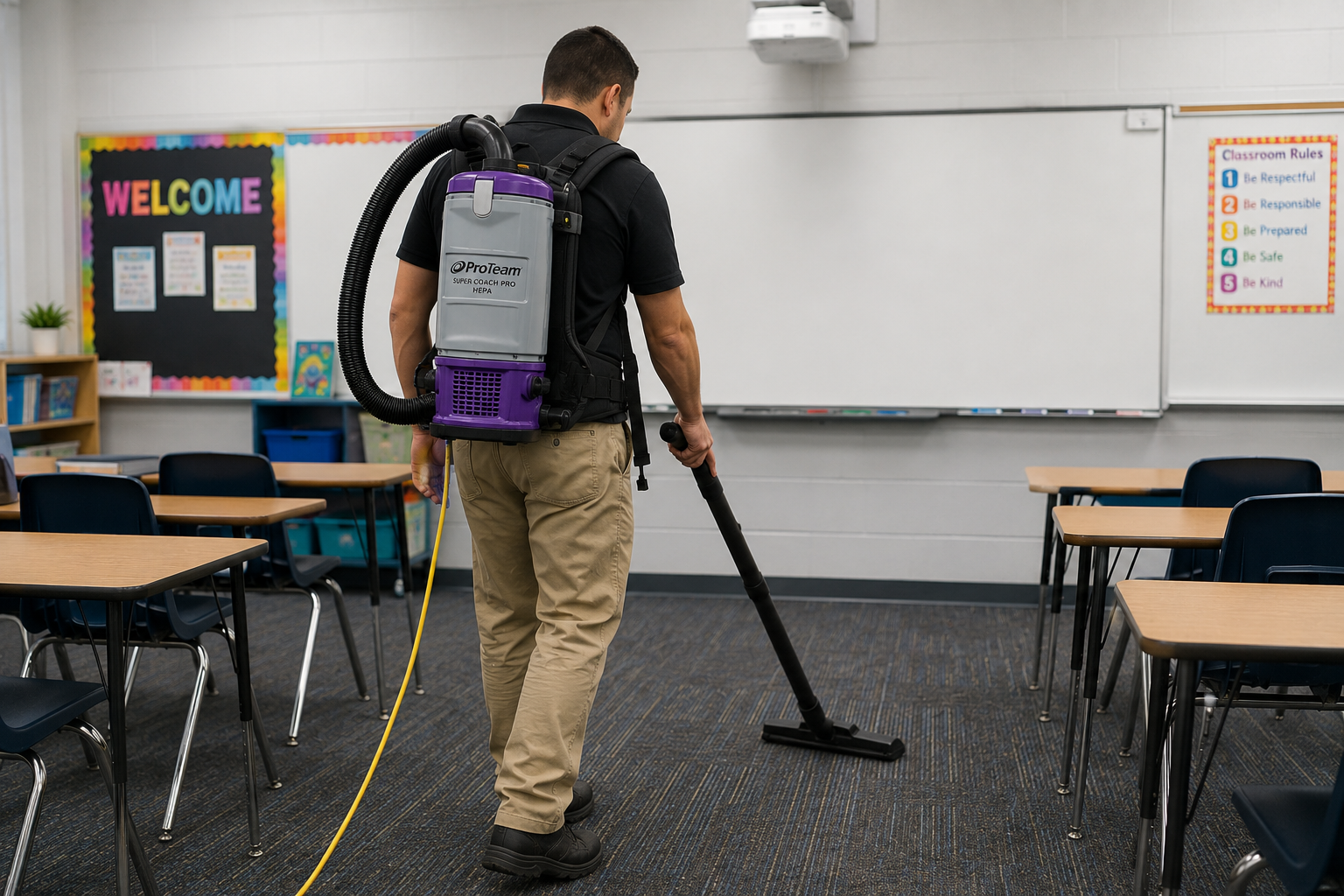
Backpack vacuums change the ergonomics of the job. The motor and collection system are carried on the operator’s back, leaving both hands free and the cleaning head free to move in any direction. The result is a cleaning pattern that follows the operator’s natural movement rather than fighting it.
The practical benefits for commercial facilities:
- Faster cleaning times. Studies in the industry have consistently shown that backpack vacuums reduce vacuuming time compared to upright models in comparable spaces. For a facility cleaning a large number of rooms in sequence, that difference compounds meaningfully over a shift.
- Better maneuverability. Backpack units reach under desks, around chair legs, into corners, and along baseboards more readily than upright vacuums. In a classroom or office environment, this means fewer missed areas and less furniture repositioning.
- Reduced operator fatigue. Carrying the weight on the back and hips — rather than pulling or pushing a unit across the floor — reduces strain on the wrists, shoulders, and lower back. For custodial staff working long shifts or covering large square footage, this is a meaningful quality-of-life improvement.
- Improved indoor air quality. Commercial backpack vacuums with HEPA filtration capture fine particles — including dust, allergens, and particulates — that standard vacuums release back into the air. For schools managing student health and allergen levels at the start of a new year, this matters.
Air Quality: Why Filtration Matters in Schools and Commercial Facilities
Indoor air quality is one of the more underappreciated aspects of a facility maintenance program. Vacuuming stirs up dust and fine particulates — and if the vacuum’s filtration is not adequate, those particles are exhausted back into the room rather than captured.
In a school setting, this is a real concern. Students with allergies, asthma, or respiratory sensitivities are directly affected by airborne particulate levels. A vacuum that distributes fine dust throughout a classroom while cleaning it is counterproductive to the goal of a clean learning environment.
Backpack vacuums equipped with HEPA (High Efficiency Particulate Air) filtration capture 99.97% of particles 0.3 microns or larger — including dust mite debris, mold spores, and fine allergens. For K-12 facilities and healthcare-adjacent environments, HEPA filtration is not a premium option — it is the appropriate standard.
D&E Supply’s Clean Degrees program supports the education market with step-by-step cleaning solutions and product sourcing designed for the operational realities of K-12 facilities. Selecting the right vacuum is one component of a broader approach to indoor environmental quality in schools.
When Backpack Vacuums Are the Right Choice
Backpack vacuums deliver the greatest advantage in specific environments. They are not the right tool for every situation, but they are genuinely the superior choice in several common commercial contexts.
Best applications for backpack vacuums:
- K-12 schools and higher education — High room counts, heavy carpet use, and allergen-sensitive populations make backpack units with HEPA filtration a strong fit.
- Building service contractors (BSC) — Custodial teams covering large commercial buildings benefit from the speed and maneuverability advantages. D&E Supply’s Smart Steps program for building service contractors emphasizes the efficiency gains that backpack vacuums enable.
- Healthcare facilities — Air quality standards and infection control considerations make HEPA filtration important.
- Hospitality — Hotels and conference centers with high room counts benefit from the speed advantage during turnover cleaning.
- Office buildings — Open-plan offices with workstations, partitions, and dense furniture benefit from the maneuverability of a backpack unit.
Where upright vacuums may still make more sense: Large open carpeted areas — conference halls, gymnasiums without bleacher seating — where an upright’s wider cleaning path is an advantage, and maneuverability around obstacles is not a factor.
What to Evaluate When Selecting a Backpack Vacuum
Not all commercial backpack vacuums are built to the same standard. Here are the key specifications to evaluate when selecting a unit for your facility:
Filtration level. For schools, healthcare, or any allergen-sensitive environment, HEPA filtration should be a non-negotiable requirement. Confirm the filtration rating, not just the marketing claim.
Motor and airflow. Cleaning performance is driven by suction, measured in cubic feet per minute (CFM), and water lift. Higher airflow means better extraction from the carpet pile. Look for units with commercial-grade motors designed for extended daily use.
Weight and harness design. A backpack vacuum that fits poorly or sits uncomfortably on the operator’s back will not deliver the ergonomic benefit it promises. Evaluate the harness design and ensure units are adjustable for different body types on your custodial team.
Collection capacity. Larger collection bags mean fewer stops to empty during a shift. In a school or office building with a high number of rooms, this affects overall cleaning speed.
Cord length. Commercial backpack vacuums typically come with 50-foot cords. In facilities with standard outlet placement, this is adequate. In larger rooms or hallways, cord management should be considered.
Filter maintenance. HEPA filters require periodic replacement to maintain their rated performance. Factor filter replacement costs and schedules into your evaluation.
Getting Your Custodial Team Ready Before Back-to-School
July is the right time to evaluate equipment — before the August rush to get buildings ready. If your school or facility is considering adding backpack vacuums to the custodial program, a few steps can help ensure a smooth transition.
Run a trial before committing to a full fleet. Test a unit on your highest-traffic carpeted spaces and have the operators who will use it daily give feedback on fit, weight, and performance. Their input matters.
Train on the harness. A backpack vacuum worn incorrectly distributes weight poorly and reduces the ergonomic benefit. Take time to walk through proper fit adjustment with each operator.
Update your cleaning route. Backpack vacuums are faster, which means your existing time estimates for vacuuming may need to be recalculated. Build a realistic route that accounts for the new productivity — and consider how the recovered time will be allocated.
Plan for filter maintenance. Build filter inspection and replacement into your regular equipment maintenance schedule. A HEPA filter past its service life reduces air-quality performance, even if the vacuum is still running.
D&E Supply’s team can help you source the right backpack vacuum for your facility type and budget, and connect you with resources from our Clean Degrees program for K-12 custodial operations.
Frequently Asked Questions
Are backpack vacuums better than upright vacuums for schools? In most school environments — multiple classrooms, carpeted hallways, densely furnished spaces — yes. Backpack vacuums are faster, more maneuverable, and deliver better air quality when equipped with HEPA filtration. For large open carpeted areas, upright vacuums with wider cleaning paths may still be efficient.
What does HEPA filtration actually mean in a commercial vacuum? HEPA stands for High Efficiency Particulate Air. A HEPA-rated filter captures 99.97% of airborne particles 0.3 microns or larger, including dust mite debris, mold spores, pollen, and fine particulate matter. In a school or healthcare environment, HEPA filtration means the vacuum captures rather than redistributes those particles.
How long do commercial backpack vacuums last? A commercial-grade backpack vacuum, with proper maintenance — regular filter replacement, bag changes, and motor inspections — should last 5 to 10 years in a commercial environment. Consumer-grade units that look similar will not hold up under daily commercial use.
How do backpack vacuums help building service contractors? Building service contractors benefit from the advantages of speed and maneuverability. Faster cleaning times per room or area translate directly into labor efficiency, which affects margins. The Smart Steps program D&E Supply offers for building service contractors includes equipment selection guidance aligned with these productivity goals.
What is the Clean Degrees program at D&E Supply? Clean Degrees is D&E Supply’s step-by-step cleaning solution system designed specifically for the education market. It helps K-12 facilities establish consistent, effective cleaning processes — including equipment and product selection — that support student health and operational efficiency.
The Right Equipment Makes the Difference Before School Starts
Back-to-school preparation puts real pressure on custodial teams. The right equipment — vacuum technology that is faster, more thorough, and better for indoor air quality — is one of the most straightforward ways to get more done in the same amount of time.
D&E Supply has been working with North Dakota schools and facilities since 1966. Our Clean Degrees program and our knowledgeable team can help you evaluate your current equipment lineup, source the right backpack vacuum for your operation, and build a custodial program that supports your facility before and throughout the school year.
Contact our team at desupply.com, browse our catalog at catalog.desupply.com, or call us at 701-255-4755. Let your problems become ours.
D&E Supply Company | 1707 E Broadway Ave, Bismarck, ND | desupply.com | 701-255-4755